



AMD’s new strategy will be the biggest change in AMD history, and with it comes some big changes. In time it means AMD will dump SOI technology for making processors, but not quite yet.
The new stratergy AMD has set out is largely about making designs that are easy to build processors around, after the specific needs of a client. This not only means major changes to how it develops new architectures, which now becomes IPblocks or jigsaw pieces that can be used in a large design. This also brings complications in the manufacturing, especially now that AMD is no longer part-owner of GlobalFoundries.
AMD has said, and confirmed by Thomas Seifert, that its entire assortment will be at 28nm in 2013. It is not the same technology and many have interpreted this as AMD is ready to dump SOI (Silicon-on-Insulator). The technology is considered one of the better to remedy leakage, but it is a pain to work with, something AMD and GlobalFoundries have faced close up with the 32 nanometer node.
AMD’s current graphics cards, Southern Islands and the coming Sea Islands, will be made with TSMC’s 28 nanometer technology. The same can be said about the coming APUs Kabini and Tamesh, which replaces Brazos 2.0 and Hondo for desktops and notebooks, and tablets.
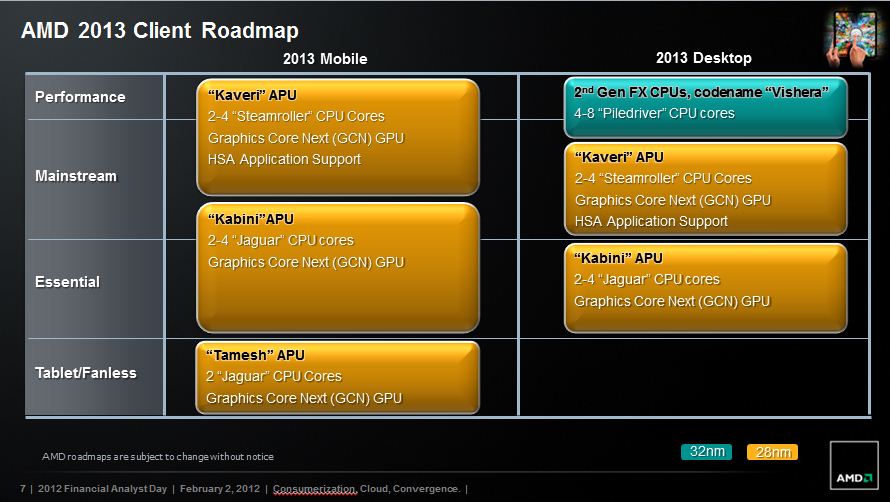 All products released in 2013 builds on 28 nanometer, but not the same technology
Its third generation APU in the upper segment, code name Kaveri, will still be made at GlobalFoundries. We have confirmation that it will be the 28 nanometer HPP technology (High Performance Plus). This will be much like the current 32 nanometer technology AMD uses, and and it is a half-node using HKMG (High-K, Metal Gate) and SOI. An well estimated guess is that the fourth generation APU will be built on the same node.
Whatever will happen after the fourth generation in 2014 is too early to say. Considering the new strategy is said to bloom that year and it will no longer be dependent on a single manufacturing partner, we are relatively confident that AMD will be moving away from SOI and instead focus on Bulk. Anything else seems unlikely, unless the entire industry decides to move over to SOI, which not entirely unlikely though. There are signs that more companies are looking at SOI, now that we are closing in on the physical limitations of silicon. It is still too early to speculate it is still too early to speculate on whether SOI will become a future industry standard. It is not impossible since even Intel considered SOI for its 22 nanometer technology, but instead decided for FinFET, also known as 3Dtransistors – the reason was price, and that FinFET could offer similar advantages at a lower production cost.
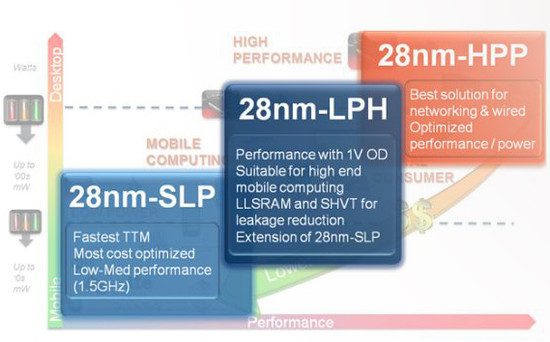 28 nanometer with SOI at GlobalFoundries and AMD”s roadmaps
We find it likely that AMD will go against the stream, toward Bulk-based manufacturing to make it easier in the future. This means the advantages of SOI no longer overcomes the drawbacks and it could be hurtful to stay with SOI. It is not impossible that the rest of the industry is moving toward SOI, but this is a question that will not be answered until a qouple of years into the future when AMD puts forth its official plans for making 22/20 nanometer processors.
Source: Seeking Alpha
No active posts found.